During a recent workday at the Northampton Free Library Pollinator Demonstration garden I was able to photograph various plants, pollinators and the larval stages of two butterflies.
The photographs are not the best but there are links with each picture to clarify identification of both host plant and caterpillar.
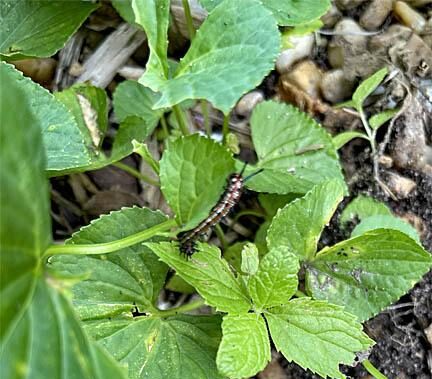
Fritillary: A Pretty Butterfly and a Good Pollinator | US Forest Service
‘Like many other butterflies, their caterpillars are very selective about what they eat. … they prefer violets … Without violets, there would be no fritillaries.‘
More details about Euptoieta claudia (Species Euptoieta claudia – Variegated Fritillary – Hodges#4447 – BugGuide.Net )
Information about the fritillary host plant (Variegated Fritillary – Alabama Butterfly Atlas)
‘Violets are spring flowering, deer-resistant perennials. … Although much maligned because of their tenacity and tendency to spread, they can function as a low-maintenance groundcover in difficult landscape situations. ‘
Two brief blurbs about violet natural history (Weed of the Month: Common Blue Violet – Brooklyn Botanic Garden and Common Violets, a Beautiful Treasure | Home & Garden Information Center ).
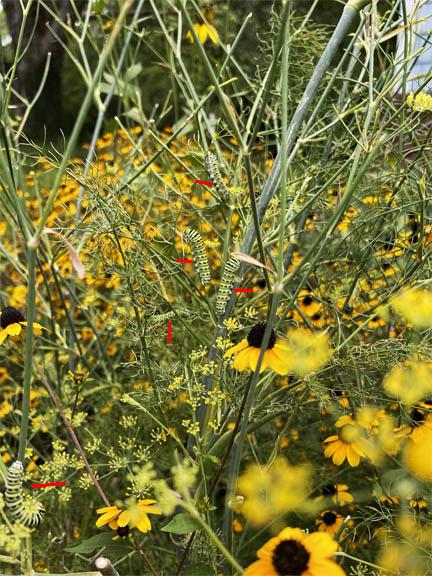
From the Northampton Library in Nassawodox a picture of caterpillars on Fennel growing close to Brown-eyed Susan
Fennel – Foeniculum vulgare (red lines point to caterpillars on Fennel)
Link for Fennel information: Foeniculum vulgare (Bronze Fennel, Fennel, Finocchio, Florence Fennel, Sweet Fennel) | North Carolina Extension Gardener Plant Toolbox
Brown-eyed susan – Rudbeckia triloba (flower with large yellow petals)
Link for Brown-eyed susan information: Rudbeckia triloba (Brown-Eyed Susan, Thin Leaved Coneflower, Three-lobed Coneflower) | North Carolina Extension Gardener Plant Toolbox
Eastern black swallowtail butterfly – Papilio polyxenes
For some gardeners the Eastern black swallowtail butterfly is considered a pest (Parsleyworm | VCE Publications | Virginia Tech ). Some consider the Eastern black swallowtail butterfly an interesting garden visitor (EENY-504/IN906: Eastern Black Swallowtail: Papilio polyxenes asterius (Stoll) (Insecta: Lepidoptera: Papilionidae)
Information on plant – lepidopteran interaction
Nectar and Host Plants for Selected Mid-Atlantic Butterflies and Moths